Google
Showing posts with label Psychology. Show all posts

Sunday, December 10, 2006

Color Psychology

Like death and taxes, there is no escaping color. It is ubiquitous. Yet what does it all mean? Why are people more relaxed in green rooms? Why do weightlifters do their best in blue gyms?

Colors often have different meanings in various cultures. And even in Western societies, the meanings of various colors have changed over the years. But today in the U.S., researchers have generally found the following to be accurate.

Black Black

Black is the color of authority and power. It is popular in fashion because it makes people appear thinner. It is also stylish and timeless. Black also implies submission. Priests wear black to signify submission to God. Some fashion experts say a woman wearing black implies submission to men. Black outfits can also be overpowering, or make the wearer seem aloof or evil. Villains, such as Dracula, often wear black.

White White

Brides wear white to symbolize innocence and purity. White reflects light and is considered a summer color. White is popular in decorating and in fashion because it is light, neutral, and goes with everything. However, white shows dirt and is therefore more difficult to keep clean than other colors. Doctors and nurses wear white to imply sterility.

Red Red

The most emotionally intense color, red stimulates a faster heartbeat and breathing. It is also the color of love. Red clothing gets noticed and makes the wearer appear heavier. Since it is an extreme color, red clothing might not help people in negotiations or confrontations. Red cars are popular targets for thieves. In decorating, red is usually used as an accent. Decorators say that red furniture should be perfect since it will attract attention.

The most romantic color, pink, is more tranquilizing. Sports teams sometimes paint the locker rooms used by opposing teams bright pink so their opponents will lose energy.

Blue Blue

The color of the sky and the ocean, blue is one of the most popular colors. It causes the opposite reaction as red. Peaceful, tranquil blue causes the body to produce calming chemicals, so it is often used in bedrooms. Blue can also be cold and depressing. Fashion consultants recommend wearing blue to job interviews because it symbolizes loyalty. People are more productive in blue rooms. Studies show weightlifters are able to handle heavier weights in blue gyms.

Green Green

Currently the most popular decorating color, green symbolizes nature. It is the easiest color on the eye and can improve vision. It is a calming, refreshing color. People waiting to appear on TV sit in "green rooms" to relax. Hospitals often use green because it relaxes patients. Brides in the Middle Ages wore green to symbolize fertility. Dark green is masculine, conservative, and implies wealth. However, seamstresses often refuse to use green thread on the eve of a fashion show for fear it will bring bad luck.

Yellow Yellow

Cheerful sunny yellow is an attention getter. While it is considered an optimistic color, people lose their tempers more often in yellow rooms, and babies will cry more. It is the most difficult color for the eye to take in, so it can be overpowering if overused. Yellow enhances concentration, hence its use for legal pads. It also speeds metabolism.

Purple Purple

The color of royalty, purple connotes luxury, wealth, and sophistication. It is also feminine and romantic. However, because it is rare in nature, purple can appear artificial.

Brown Brown

Solid, reliable brown is the color of earth and is abundant in nature. Light brown implies genuineness while dark brown is similar to wood or leather. Brown can also be sad and wistful. Men are more apt to say brown is one of their favorite colors.

Friday, November 17, 2006

Mere Thought of Money Makes People Selfish

Just the mere thought of money can turn a person selfish, so that he helps others less often and prefers to play alone, a new study shows.

In a series of nine experiments, researchers found that money enhanced people's motivation to achieve their own goals and degraded their behavior toward others. The concept of money, they suggest, makes a person feel more self-sufficient and thus more apt to stand alone.

The scientists said the study had nothing to do with making a person feel wealthy. When real or fake money, or even a photo of cash, was placed in sight of participants, they became selfish.

The results could explain why the topic of money can be so detrimental to a couple’s lasting bond.

“In our experiments, the people who are reminded of money really worked hard toward their own goals. But that might not be conducive to a good interpersonal relationship,” said study leader Kathleen Vohs of the Carlson School of Management at the University of Minnesota.


I've stumbled upon this at this webpage.

Friday, November 10, 2006

Become a Lie Detector

Introduction to Detecting Lies:

The following techniques to telling if someone is lying are often used by police, and security experts. This knowledge is also useful for managers, employers, and for anyone to use in everyday situations where telling the truth from a lie can help prevent you from being a victim of fraud/scams and other deceptions.

Warning: Sometimes Ignorance is bliss; after gaining this knowledge, you may be hurt when it is obvious that someone is lying to you.


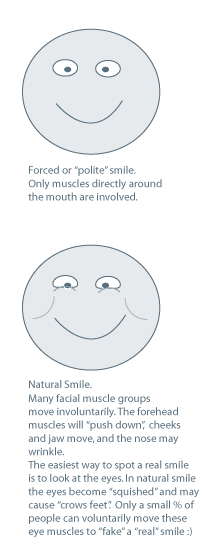
Fake smile
Signs of Deception:
Body Language of Lies:


• Physical expression will be limited and stiff, with few arm and hand movements. Hand, arm and leg movement are toward their own body the liar takes up less space.

• A person who is lying to you will avoid making eye contact.

• Hands touching their face, throat & mouth. Touching or scratching the nose or behind their ear. Not likely to touch his chest/heart with an open hand.


Emotional Gestures & Contradiction

• Timing and duration of emotional gestures and emotions are off a normal pace. The display of emotion is delayed, stays longer it would naturally, then stops suddenly.

• Timing is off between emotions gestures/expressions and words. Example: Someone says "I love it!" when receiving a gift, and then smile after making that statement, rather then at the same time the statement is made.

• Gestures/expressions don’t match the verbal statement, such as frowning when saying “I love you.”

• Expressions are limited to mouth movements when someone is faking emotions (like happy, surprised, sad, awe, ) instead of the whole face. For example; when someone smiles naturally their whole face is involved: jaw/cheek movement, eyes and forehead push down, etc.


Interactions and Reactions

• A guilty person gets defensive. An innocent person will often go on the offensive.

• A liar is uncomfortable facing his questioner/accuser and may turn his head or body away.

• A liar might unconsciously place objects (book, coffee cup, etc.) between themselves and you.


Verbal Context and Content

• A liar will use your words to make answer a question. When asked, “Did you eat the last cookie?” The liar answers, “No, I did not eat the last cookie.”

•A statement with a contraction is more likely to be truthful: “ I didn't do it” instead of “I did not do it”

• Liars sometimes avoid "lying" by not making direct statements. They imply answers instead of denying something directly.

• The guilty person may speak more than natural, adding unnecessary details to convince you... they are not comfortable with silence or pauses in the conversation.

• A liar may leave out pronouns and speak in a monotonous tone. When a truthful statement is made the pronoun is emphasized as much or more than the rest of the words in a statement.

• Words may be garbled and spoken softly, and syntax and grammar may be off. In other
words, his sentences will likely be muddled rather than emphasized.


Other signs of a lie:

• If you believe someone is lying, then change subject of a conversation quickly, a liar follows along willingly and becomes more relaxed. The guilty wants the subject changed; an innocent person may be confused by the sudden change in topics and will want to back to the previous subject.

• Using humor or sarcasm to avoid a subject.


Final Notes:

Obviously, just because someone exhibits one or more of these signs does not make them a liar. The above behaviors should be compared to a persons base (normal) behavior whenever possible.


I've stumbled upon this at this webpage.